
University of Toronto Faculty of Law, Canada – Courses, Fees, Admissions, Rankings & Eligibility (2026)



Description
About the University and Faculty of Law
by law section.in editorial team | Last Updated: June 06, 2026
The University of Toronto Faculty of Law (officially the Henry N.R. Jackman Faculty of Law) is widely recognised as one of Canada’s leading law schools and consistently ranks among the world’s top law faculties. Located in Toronto, Ontario—the legal, financial, and commercial centre of Canada—the Faculty of Law offers internationally respected legal education, cutting-edge legal research opportunities, extensive experiential learning, and strong connections with major law firms, courts, government agencies, and multinational organisations.
Students exploring leading institutions through the Law Colleges in Canada hub frequently consider the University of Toronto Faculty of Law because of its academic excellence, global reputation, strong graduate outcomes, and extensive international opportunities. The Faculty attracts students from Canada, India, the United States, Europe, Australia, New Zealand, Asia, Africa, and the Middle East, making it one of Canada’s most internationally recognised destinations for legal education.
University Recognition Snapshot
Institution Type
Public Research University located in Toronto, Ontario, Canada and recognised as one of Canada’s leading higher education institutions.
University Status
Established in 1827, the University of Toronto is among Canada’s oldest and most prestigious public universities with a strong global academic reputation.
Law School Recognition
The University of Toronto Faculty of Law is widely recognised as one of Canada’s top law schools and is respected globally for legal education, scholarship, and professional training.
Government Recognition
The University operates under the authority of the Province of Ontario and is a recognised public university authorised to award undergraduate, professional, graduate, and doctoral degrees.
Global Rankings Reputation
Consistently ranked among the world’s leading universities and recognised internationally for excellence in Law and Legal Studies by major global ranking organisations.
Research Excellence
The Faculty of Law is internationally known for influential legal research, public policy contributions, interdisciplinary scholarship, and global academic collaboration.
Primary Law Campus
St. George Campus, Toronto, Ontario, Canada — located in the heart of Canada’s largest legal, financial, governmental, and business centre.
International Student Community
Welcomes students and researchers from across the world, including India, the United States, the United Kingdom, Europe, Australia, New Zealand, Asia, Africa, and the Middle East.
Official Sources:
University of Toronto Official Website
University of Toronto Faculty of Law Official Website
“`html
Law Programs Offered at University of Toronto Faculty of Law (2026)
Explore internationally recognised Juris Doctor (JD), Master of Laws (LLM), Global Professional Master of Laws (GPLLM), Master of Studies in Law (MSL), and Doctor of Juridical Science (SJD) programs offered by the University of Toronto Faculty of Law, one of Canada’s most prestigious and globally respected law schools.
Professional Law Degree Programs
Juris Doctor (JD)
Duration: 3 Years Full-Time
Approx Tuition Fee: Refer to the latest University of Toronto official tuition schedule applicable at the time of admission.
Eligibility: Completion of a recognised bachelor’s degree or equivalent with a competitive academic record.
Additional Requirement: LSAT score generally required as part of the admission process.
English Requirement: Applicants whose previous education was not conducted in English may be required to satisfy University of Toronto English language requirements.
Campus: St. George Campus, Toronto, Ontario, Canada
Available Intake: September
Program Highlights: Strong emphasis on experiential learning, legal research, mooting, clinical education, public interest law, corporate law, international law, and interdisciplinary legal studies.
Official Program Source:
View Official JD Program
Postgraduate Law Programs
Master of Laws (LLM)
Duration: 1 Year Full-Time
Approx Tuition Fee: International tuition fees are published annually by the Faculty of Law and University of Toronto.
Eligibility: Bachelor of Laws (LLB), Juris Doctor (JD), or equivalent recognised law degree.
English Requirement: University of Toronto Graduate Studies English language requirements apply.
Campus: St. George Campus, Toronto
Available Intake: September
Study Areas: Business Law, Criminal Law, Constitutional Law, Legal Theory, Health Law, Ethics & Policy, International Law, and related advanced legal fields.
Official Program Source:
View Official LLM Program
Global Professional Master of Laws (GPLLM)
Duration: Approximately 12 Months
Approx Tuition Fee: Refer to the official GPLLM tuition schedule.
Eligibility: Recognised bachelor’s degree and relevant professional experience. Legal background may be advantageous but is not mandatory for all pathways.
English Requirement: Graduate admissions English language requirements apply.
Campus: Toronto, Ontario
Available Intake: September
Popular Concentrations: Business Law, Canadian Law in a Global Context, Innovation, Technology Law, Leadership, and Professional Practice.
Official Program Source:
View Official GPLLM Program
Master of Studies in Law (MSL)
Duration: Typically 1 Year Full-Time
Approx Tuition Fee: Subject to annual University of Toronto fee schedules.
Eligibility: Intended primarily for scholars, academics, policymakers, and professionals from non-law disciplines whose work intersects with legal issues.
English Requirement: Graduate admission standards apply.
Campus: Toronto, Ontario
Available Intake: September
Program Focus: Legal foundations, legal institutions, public policy, regulation, governance, and interdisciplinary legal scholarship.
Official Program Source:
View Official MSL Program
Research & Doctoral Law Programs
Doctor of Juridical Science (SJD)
Duration: Typically 3–5 Years
Tuition Fee: Subject to annual graduate tuition schedules and applicable funding arrangements.
Eligibility: Outstanding academic achievement and advanced legal qualifications, usually including an LLM or equivalent postgraduate legal degree.
English Requirement: University of Toronto Graduate Studies English language requirements apply.
Campus: St. George Campus, Toronto
Available Intake: September
Research Areas: Constitutional Law, Human Rights, International Law, Commercial Law, Tax Law, Technology Law, Legal Theory, Indigenous Law, Environmental Law, Criminal Justice, and Public Policy.
Official Program Source:
View Official SJD Program
Important Note for International Students
Program availability, tuition fees, admission requirements, scholarships, English language standards, immigration regulations, and Canadian study permit policies may change periodically. International applicants should always verify the latest information directly through official University of Toronto sources before making any admission, financial, or immigration decision.
Official University Website:
University of Toronto
Official Faculty of Law Website:
University of Toronto Faculty of Law
“`
Is University of Toronto good for law?
Yes, the University of Toronto Faculty of Law is ranked #1 in Canada and among the top 20 globally for law. It offers internationally recognized JD and LLM programs, strong placement in top law firms, and excellent opportunities for global legal careers.
Global Recognition, Accreditation & Ranking Excellence
The University of Toronto Faculty of Law stands among the most trusted and globally respected law schools. Its accreditation by key Canadian legal authorities and consistently high global rankings make it a top destination for students aiming for international legal careers, elite law firms, and academic excellence.
Recognized by Law Society of Ontario
The Juris Doctor (JD) program is officially recognized by the Law Society of Ontario, ensuring that graduates are eligible to enter the licensing process and practice law in one of Canada’s largest legal markets.
Approved Canadian Common Law Program
The program is approved by the Federation of Law Societies of Canada, confirming that it meets national standards for legal education and professional competency across Canada.
Top Global Law School Ranking
Ranked among the top 20 law schools globally by QS World University Rankings 2025, the university reflects strong academic performance, research output, and global reputation.
Ranked #1 in Canada for Law
The Faculty of Law consistently holds the #1 position in Canada, making it the most prestigious destination for legal studies within the country.
Strong Employer & Industry Reputation
Graduates are highly preferred by top law firms, multinational corporations, and judicial institutions, reflecting the university’s strong employer trust and industry relevance.
Public University with Global Credibility
As a public institution recognized by the Government of Ontario and a member of Universities Canada, the university maintains high standards of transparency, quality, and global academic credibility.
These recognitions and rankings collectively establish the University of Toronto Faculty of Law as a globally trusted institution for legal education, offering strong career outcomes, international mobility, and long-term professional credibility.
Why Choose University of Toronto Faculty of Law?
The University of Toronto Faculty of Law offers one of the most prestigious and internationally recognised legal education experiences in Canada.
Documents Required for University of Toronto Law Admission
Applicants must submit verified academic and legal documents as per University of Toronto Faculty of Law admission requirements to ensure eligibility and successful application processing.
- Academic transcripts and degree certificates (LLB or equivalent for LLM applicants)
- English language proficiency test score (IELTS / TOEFL / PTE as applicable)
- Statement of Purpose (mandatory for LLM and SJD programs)
- Letters of Recommendation (required for advanced and research programs)
- Valid passport copy for international application and visa processing
- LSAT score report (mandatory only for JD applicants)
- Updated CV or resume (recommended for LLM and Global Professional LLM applicants)
All document requirements are verified from official University of Toronto Faculty of Law admission guidelines and updated as per 2026 international admission standards.
How to Apply to University of Toronto Law (Step-by-Step Admission Process)
Follow this structured application process to successfully apply for JD, LLM, or SJD programs at the University of Toronto Faculty of Law as an international student.
- Select your law program (JD, LLM, Global LLM, or SJD) based on career goals and eligibility
- Review admission requirements including academic qualifications, English test scores, and entrance exams
- Prepare all required documents such as transcripts, SOP, LORs, and LSAT score (if applicable)
- Submit your application through the official university portal (OLSAS for JD applicants)
- Track application status and respond to any additional requirements or interviews
- Receive admission offer and confirm acceptance within the given timeline
- Apply for Canadian Study Permit (Student Visa) with admission letter and financial proof
Following the correct application process significantly improves admission success rates for international students applying to top-ranked law schools like the University of Toronto.
Other Law Schools and Legal Education Institutions in Toronto
Toronto is Canada’s largest legal education hub and hosts several respected law schools and legal education providers.
Osgoode Hall Law School
Part of York University, Osgoode Hall Law School is among Canada’s oldest and most respected law schools, offering JD, LLM, PhD, and professional legal education programmes.
Toronto Metropolitan University – Lincoln Alexander School of Law
Located in downtown Toronto, this modern law school focuses on innovation, technology, entrepreneurship, access to justice, and practical legal training.
University of Toronto Faculty of Law
One of Canada’s most internationally recognised law schools offering JD, LLM, GPLLM, MSL, and SJD pathways.
Faculty of Law Programs Through Nearby Ontario Universities
Students in Toronto also frequently explore programmes offered by institutions across Ontario, including opportunities in public policy, legal studies, criminology, governance, and interdisciplinary legal research.
Editorial Review Statement – This institutional profile has been researched and reviewed by the Lawsection.in Editorial Team using official University of Toronto Faculty of Law publications, admission resources, tuition schedules, and graduate programme information available as of June 2026. Applicants should always verify tuition fees, admission requirements, English language standards, programme availability, and application deadlines directly from the official University of Toronto Faculty of Law website before submitting an application.

Continue Learning (Previous Guide)
Choosing the Right Law College for LLM Abroad?
LLM abroad helps Indian law graduates gain international exposure, specialised legal knowledge, and global career opportunities.
Related Guide for Students want to study in Canada
Students interested in pursuing legal education in Canada can also explore:
- Complete Guide to Study Law Abroad
- Law Colleges in Canada
- PR Pathways After LLM in Canada (2026–2027): Immigration Options for Law Graduates
- Best One-Year LLM Programs in Canada (2026–2027): Fast-Track Law Degrees
- BEST SPECIALIZATIONS IN LLM CANADA (CORPORATE LAW, IP, BUSINESS LAW) WITH SALARY 2026
- Cost of Studying LLM in Canada (2026): Fees, Living Expenses & Scholarships
- Jobs After LLM in Canada (2026): Salary, Law Firms, Work Permit & Reality for Indian Lawyers
- Can Indian Lawyers Practice in Canada? NCA Process Explained (2026 Step-by-Step Guide)
- Is LLM in Canada Worth It in 2026? Salary vs Cost vs PR Reality
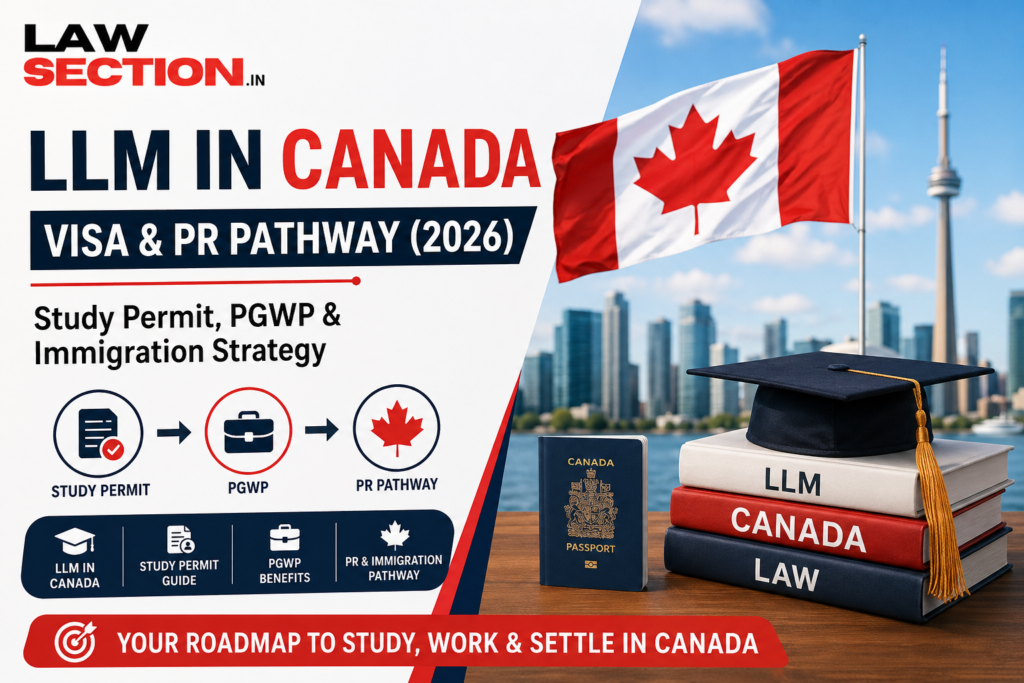
- LLM in Canada Visa & PR Pathway (2026): Study Permit, PGWP & Immigration Strategy
Frequently Asked Questions (FAQs)
1. Is this law degree valid for legal practice in Canada?
Yes. The JD program complies with Federation of Law Societies of Canada requirements and qualifies graduates for provincial bar licensing (subject to articling & bar exams).
2. Is LSAT required for admission?
Yes, LSAT is mandatory for JD applicants. Not required for LLM or SJD programs.
3. Can Indian students practice law after this degree?
Yes, after completing JD + provincial licensing requirements. LLM students must undergo NCA evaluation.
4. What is the average tuition fee for international students?
Approximately CAD 40,000–55,000 per year (subject to official annual updates).
5. What intake months are available?
Primary intake is September each academic year.
Related Guides for LLM in Canada
Planning to pursue an LLM in Canada? Explore our carefully curated and verified guides covering top-ranked law universities across Canada. These resources provide clear and structured insights into admission requirements, eligibility criteria, tuition fees, intake periods, scholarships, and career opportunities — all based on official university sources and updated for 2026.


Address







Cardiff Metropolitan University, UK – Law Courses, Fees, Eligibility, Admissions 2026
- Government
- LLB (3 Years), LLM Abroad, Juris Doctor (JD), PhD in Law




Wrexham University Law Courses in UK (2026): Fees, Entry Requirements, Admissions & Student Guide
- Government
- LLB (3 Years), LLM Abroad, Juris Doctor (JD), PhD in Law



Cardiff University, UK – Law Courses, Fees, Admission Requirements & Study Opportunities (2026)
- Government
- LLB (3 Years), LLM Abroad, Juris Doctor (JD), PhD in Law


Swansea University Law School (UK): Courses, Fees, Eligibility, Admissions, Rankings & Study Guide 2026
- Government
- LLB (3 Years), LLM Abroad, Juris Doctor (JD), PhD in Law



Bangor University, UK – Law Courses, Fees, Eligibility, Admissions & Bangor Law School Guide (2026)
- Government
- LLB (3 Years), LLM Abroad, Juris Doctor (JD), PhD in Law



Queensland University of Technology Law School Australia: Courses, Fees, Eligibility, Admissions & Career Opportunities 2026
- Government
- LLB (3 Years), LLM Abroad, Juris Doctor (JD), Doctor of Juridicial Science (S.J.D), PhD in Law



Griffith University, Australia – Complete Guide to Law Programs, Fees, Eligibility, Campuses & Admissions (2026)
- Government
- LLB (3 Years), LLM Abroad, Juris Doctor (JD), Doctor of Juridicial Science (S.J.D), PhD in Law
